The Commercial Illusion – Inclusive by Design, Exclusive by Invoice
Imagine a television commercial. It’s peak hour. A new, gleaming blue Ford vehicle moves smoothly down a clear highway. The driver and the front passenger are engaged in a lively, animated conversation. They aren’t looking at each other, yet they are fully connected. Why? Because they are using American Sign Language (ASL). They are communicating freely while the car’s advanced automated system handles the lanes, the speed, and the boundaries.
It is a beautiful, powerful piece of inclusive marketing. It shows a world where advanced technology doesn’t just make driving easier; it makes human connection possible.
“A disability is not an inability, but a corporate subscription tollbooth on safety certainly creates one.”
Now, imagine the commercial continues…
Just as the conversation reaches its peak, a large, digital tollbooth graphic appears on the windshield. A mechanical voice announces:
“Your introductory free trial of human autonomy has expired. To continue communicating in your primary language while safely navigating the highway, please subscribe for $495/year. Failure to pay will result in the immediate return to cognitive and physical fatigue.”
Suddenly, the inclusive masterpiece becomes a satire of the modern subscription economy. While this isn’t exactly how Ford or other automakers advertise, it is precisely how their pricing models function for millions of people with disabilities. The technology touted as a cornerstone of emotional connection is, in reality, locked behind an annual wealth barrier that denies basic equity.
The Core Contradiction—Gating Convenience vs. Gating Survival
Corporate leadership at companies like Ford, Tesla, General Motors, and major tech giants must understand that gating software is not a monolith. When you move an advanced driver assistance system (ADAS)—like BlueCruise, FSD, or Super Cruise—behind a recurring paywall after a program trial length, you are doing two entirely different things to two entirely different user bases.
The Standard Driver: A Subscription for Pleasure and Comfort
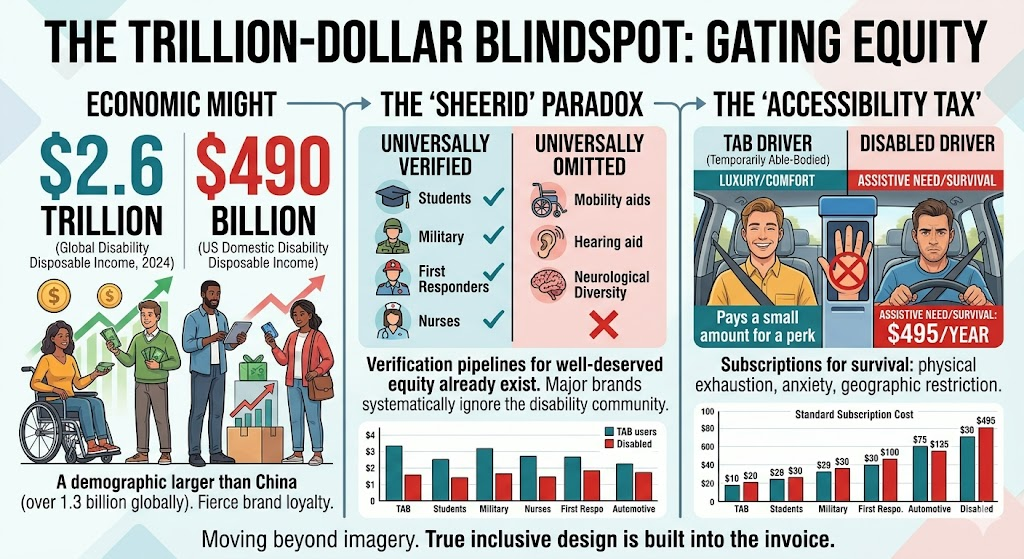
For a temporarily able-bodied (TAB) driver, hands-free highway driving is a luxurious perk. It is about comfort. It is about being slightly less tired after a five-hour trip. When the $495/year bill arrives, they can make a discretionary choice: “Do I value that extra comfort enough to pay the fee?” If they decline, their driving experience returns to the standard, functional level of manual driving. It is a loss of a luxury.
The Driver with a Disability: A Subscription for Need and Survival
For a driver with a physical disability, chronic pain, motor control challenges, severe fatigue, or neurological differences, that same hands-free system is an adaptive necessity. It is not about “pleasure”; it is about preserving energy, mitigating strain, and fundamentally maintaining safe, independent mobility.
Forcing these users to lose access to ADAS doesn’t just cause a drop in “comfort.” Research indicates it results in severe drops in life satisfaction, coupled with spikes in clinical isolation, anxiety, and depression (Virginia Tech Transportation Institute, 2024).
By placing this adaptive layer behind a permanent tollbooth, these companies are imposing a literal “accessibility tax” on a demographic that historically faces massive systemic economic disparities and lower employment rates. They are monetizing the need for survival, comfort, and equity.
The Macroeconomic Blindspot—The Multi-Trillion Dollar Market Nobody Talks About
This corporate decision isn’t just morally questionable; it is a profound business failure driven by ignorance of macroeconomic realities. Boards often view accessibility accommodations as a compliance-driven cost center or a niche market.
They are completely wrong.
People with Disabilities are a Global Economic Powerhouse
Working-age individuals with disabilities globally are a consumer demographic larger than the population of China (The Return on Disability Group, 2024).
- Collective Disposable Income: Working-age adults with disabilities in the US, UK, EU, and Canada command a disposable income of $2.6 trillion USD (The Return on Disability Group, 2024).
- US Domestic Impact: In the United States alone, the annual disposable income of working-age adults with disabilities is nearly half a trillion dollars ($490B+) (Yin et al., 2018).
This is a massive, capital-wielding market force. Brands that gate safety and assistive features behind a continuous paywall are not just alienating an individual; they are actively insulting a multi-trillion-dollar consumer ecosystem built on fierce brand loyalty. When a company validates and includes the disability community, they often win the loyalty of their massive secondary networks of family, friends, and caretakers. Gating accessibility gates profit.
The Automotive Subscription Maze
The automotive landscape is racing toward recurring SaaS (Software-as-a-Service) revenue models, turning hardware you purchased into a perpetual cash drain. For advocates, understanding the playing field is key.
| Automaker | Driving System | Current Annual Subscription Price | The Functional Reality of Gating |
| Ford | BlueCruise | ~$495 / year | Actively markets inclusive ASL use, but creates a systematic wealth barrier to that exact access after a brief trial. |
| General Motors | Super Cruise | ~$40 / month | Projected to generate $400M in revenue this year. Penalizes people who rely on it to reduce physical fatigue just to keep their car manageable. |
| Tesla | FSD (Supervised) | ~$99 / month (Changed heavily away from a one-time purchase) | For individuals with specific physical or neurological needs, autonomous safety layers act as a required survival buffer. |
| Rivian/Lucid | Highway Assist Systems | ~$50 / month (projected) | Capitalizes on user dependence. Turning off an ADAS that mitigates a physical challenge feels like an active penalty. |
“When advanced driver assistance features are gated behind a recurring paywall, a able-bodied driver loses a luxury. A driver with a disability loses an accommodation. That isn’t a premium upgrade—it is an accessibility tax.”
The “SheerID” Disconnect—The Infrastructure for Equity Exists
The final, and perhaps most frustrating, angle of this contradiction is the structural hypocrisy. Tech and automotive companies have completely mastered the infrastructure required to issue gated, well-deserved equity.
When you reach the checkout of almost any major brand, you are offered instant verification through platforms like SheerID or ID.me for well-deserved discounts. Companies seamlessly verify:
- Students and Faculty
- Active Military and Veterans
- First Responders (Police, Fire, EMS)
- Medical Professionals (Nurses, Doctors)
Every one of these groups deserves their discounts. But if these verification platforms can seamlessly confirm background to grant a price reduction, they can identical, streamlined pathway to an Accessibility Waiver.
Major tech and automotive companies completely omit people with disabilities from their verification pipelines. If a student can get 50% off a software stack, a person who requires an assistive software layer—like BlueCruise or AI prosthetics—to level the playing field should have an identical, dignified pathway to permanent access without recurring fees.
“We have built a digital economy where a person can seamlessly buy a car, but must continually pay a subscription fee just to maintain the physical stamina required to drive it.”
The Way Forward—Moving Beyond Imagery and Demanding Structural Equity
The path forward requires a unified, data-backed demand from the advocacy community. It is time for automakers to move past marketing imagery that uses our culture for brand equity. True equity means ensuring that the technology required for independent survival is never locked behind a corporate tollbooth.
The Advocacy Call to Action:
- Demand an “Autonomous Accessibility Waiver”: We must advocate for companies to implement an automated verification system. If a user can provide evidence of a long-term disability in which hands-free driving, ADAS, or AI is necessary as an adaptive accommodation, the recurring subscription fee must be waived.
- Highlight the Legal Vector: Regulatory bodies are beginning to view automated vehicle layers through a human rights lens. Legislation such as the re-introduced bipartisan Autonomous Vehicle Accessibility Act (AVAA), introduced in July 2025, aims to re-engineer traditional legal constructs of “driver vs. passenger” under the ADA (Stanton & Mast, 2025). Gating these systems risks public relations and regulatory liability.
- Mobilize the Trillion-Dollar Market: We must utilize our shared economic voice. Brands need to understand that the multi-trillion-dollar disability market ecosystem will remain fiercely loyal only to companies that respect our need for inclusion, not just in their ads, but on their invoices.
There is one thing about making money, but it is another thing entirely about the needs of people with disabilities. Comfort and pleasure are negotiable luxuries; survival, safety, and independence are not.
🔌 Plugged-In Moments
Real Talk. No Filter.
Disclaimer: Welcome to my private corner of the page. The thoughts below represent my personal perspective alone—unvarnished, unfiltered, and strictly my own. They do not reflect the viewpoints of any brands, corporate partners, or anyone else. Just me, talking to you.
📈 The Economic Powerhouse (Data-Driven Callouts)
“Capturing the disability market isn’t a corporate charity initiative; it’s a multi-trillion-dollar business strategy that modern tech giants are actively ignoring.”
“With over $2.6 trillion in global disposable income, the disability community commands an economic footprint larger than entire nations. Yet, we are still treated as an afterthought on the corporate invoice.”
“If your product design is inclusive but your pricing model is exclusive, your commitment to diversity ends exactly where your quarterly revenue goals begin.”
🎯 The Satirical & Corporate Challenge (The Marketing Paradox)
If a technology is life-changing enough to feature as the emotional anchor of your national television commercials, it is essential enough to be free for the very community that inspired it.
There is a profound ethical mismatch when a company spends millions to film a commercial showcasing human inclusion, only to charge the consumer $495 a year to keep that inclusion turned on.
True universal design cannot exist behind a SaaS subscription model. You cannot market independence while billing for autonomy on a month-to-month basis.
I had a chief marketing officer who coined the term “toll gate.” It was used when you wanted to propose a new marketing plan; it had to be presented to a large group of people from different lines of business within marketing. Everyone would discuss what would come next after it was approved, what problems might arise, and any issues. Proposals could be sent back for creative differences. It was something people hated, but at the end of the day it forced you to think more carefully before you submitted.
So here’s my thought: Did anyone at @ford sit in a boardroom and think about the reality of what they built? They created a commercial with two people using sign language to promote BlueCruise in a Mustang Mach-E. It was beautiful. But did they ever consider what happens when the free trial runs out? If those drivers can’t afford the $495 annual fee, the car shuts off the accommodation. They are forced to put their hands back on the wheel. The conversation ends. They are effectively punished, forced to drive in silence when the rest of the world might already feel silent enough. It makes me wonder: since when did a person with a disability have to pay a subscription fee just to communicate inside their own vehicle?
Let’s be entirely honest for a second. We talk a big game about innovation in 2026, but if our best technological leaps are locked behind a monthly subscription model for the people who actually need them to survive the highway, we haven’t innovated anything—we’ve just built a digital toll road. – Dr. Eric Fishon, Storyteller, Dr. Disruptor Network
APA Citations
Autonomous Vehicle Accessibility Act [AVAA], H.R. ____, 119th Cong. (2025). https://stanton.house.gov/2025/7/stanton-mast-introduce-bipartisan-bill-to-make-autonomous-vehicles-more-accessible-for-people-with-disabilities
The Return on Disability Group. (2024). The global economics of disability report: 2024. AccessibleEU Centre. https://www.rod-group.com/wp-content/uploads/2024/09/The-Global-Economics-of-Disability-2024-The-Return-on-Disability-Group-September-24-2024.pdf
Virginia Tech Transportation Institute. (2024). Assessing the impact of disability on drivers’ equitable use of Advanced Driver Assistance Systems (ADAS). VTechWorks.
Yin, M., Shaewitz, D., Overton, C., & Smith, K. (2018). The purchasing power of working-age adults with disabilities. Institute for Educational Leadership.